

24/08/2026
-
Products
-
V Series
-
-
-
-
Explore
- About Us
- Where to Buy
- Support
Products
V Series
Explore
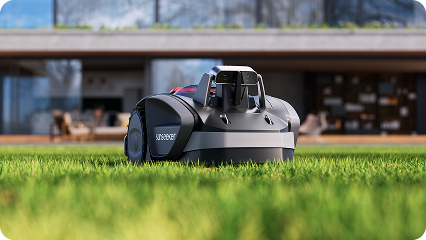
A Wi-Fi robot lawn mower uses the home network mainly for app schedules, map edits, alerts, and updates—not as the only way it finds its way around. Judge signal at the dock and the farthest zone, keep offline schedules working, and match coverage to real grass area. Bluetooth or 4G can fill gaps when Wi-Fi drops at the lawn edge.
The charging dock can sit next to a strong home router while the far corner of the lawn barely receives Wi-Fi. That does not automatically stop mowing, but it can affect app status, map edits, alerts, or remote commands. A wifi robot lawn mower should therefore be judged on both connectivity and its behavior when connectivity is weak. This guide explains the app and coverage questions to check, then compares Wi-Fi with Bluetooth and 4G for different yard and control needs.
Connectivity is useful only when it supports everyday mower control without creating new points of friction. The buying decision should focus on how the connected workflow behaves across the whole yard.
A Wi-Fi mower depends on the app for setup, schedules, map edits, alerts, and software updates, so the interface should remain responsive even when the mower is at the edge of home coverage. Check how the app reports offline status and whether core mowing schedules continue locally if the internet connection drops. Firmware update history and clear error messages matter more than decorative controls. During setup, confirm the account, mower, and charging station are paired correctly before building a complex map; solving connectivity first prevents later map or schedule troubleshooting from becoming ambiguous.
Home Wi-Fi can be strong indoors and weak only a few meters outside because exterior walls, foil insulation, metal siding, and landscaping attenuate the signal. Walk the yard with a phone and note where the connection changes, but remember that the mower antenna sits much lower than a handheld device. For a 2.4 GHz network, coverage is often better than 5 GHz at distance, although interference can be higher. The mower should not need continuous Wi-Fi for every movement, but stable coverage near the dock and key control areas improves app communication and update reliability.
Remote features are most useful for starting or pausing a task, changing schedules, editing zones, locating the mower, and reviewing status without walking outside. They should complement autonomous operation rather than require constant manual steering. Check whether remote commands work only on the local network or also through cloud connectivity, and how the app handles authentication. Alerts for rain, lift, theft, or faults are valuable when they explain what action is needed. A clear activity history also helps diagnose repeated issues such as one passage that causes frequent interruptions.
Coverage should be based on the sum of all mowable areas, not the property lot size. Subtract buildings, beds, ponds, patios, and non-grass surfaces, then add a margin for seasonal growth and inefficient routing. A mower rated close to the exact calculated area may spend more time charging during fast spring growth. For example, if three lawn zones total about 3,238 m², selecting a system comfortably above 3,238 m² provides more schedule flexibility than treating the rating as a daily guarantee. Terrain, grass density, cutting height, and travel between zones all affect real cycle time.
Cutting-height range should match the grass type and the way the lawn is used. A wider adjustment range gives room to keep turf longer during heat or shade and gradually lower it when growth is strong. Avoid removing more than roughly one-third of the leaf blade in a single cut; if grass is overgrown, reach the target height over several sessions. App-controlled height is convenient, while manual adjustment is acceptable when the yard does not need frequent changes. Check the mower’s actual range against the height you normally maintain rather than choosing on range alone.
Bluetooth is useful for close-range pairing and local setup when Wi-Fi is unavailable. Cellular connectivity can provide remote status or anti-theft functions beyond home Wi-Fi, but it may be optional, subscription-based, or region dependent. The best mix depends on the property. A compact yard next to the house may work well with Wi-Fi and Bluetooth alone, while a large or remote lawn can benefit from a cellular link. Verify which features depend on each radio so loss of one connection does not unexpectedly remove a function you consider essential.
Once the yard requirements are clear, the product decision can be narrowed to the navigation, traction, coverage, and cutting features that matter most in that setting.
For compact complex yards, Sunseeker S4 combines Wi-Fi/Bluetooth connectivity with 360° 3D LiDAR plus AI Vision for local mapping. It has up to 1000 m² coverage, 100 multi-zones, an 18 cm cutting width, a 20-60 mm cutting-height range, and slopes up to 42% / 22°. It is a strong fit where the garden stays close to the house but includes shade, trees, narrow sections, or several small working zones that benefit from editable virtual boundaries. Check app connectivity at the dock, the main mapping area, and the farthest zone so weak Wi-Fi does not surprise you during edits or status checks.
For medium sloped yards, Sunseeker S5 combines Wi-Fi/Bluetooth connectivity with RTK + VSLAM navigation and all-wheel drive. It has up to 1600 m² coverage, 80 zones, a 20 cm cutting width, a 20-60 mm cutting-height range, and slopes up to 60% / 30°. The fit is strongest when the yard needs connected app functions as well as traction and navigation across changing grades, rather than choosing Wi-Fi as an isolated feature. Because navigation and connectivity are separate systems, verify both the mowing route and the app connection in the hardest part of the yard before relying on remote control alone.
Wi-Fi, Bluetooth, and 4G serve different communication ranges and tasks on a smart mower. Their importance changes with where the mower works and how the owner expects to control it.
Bluetooth matters most during nearby setup, pairing, or troubleshooting because it does not depend on the home router. 4G becomes more valuable when the mower works beyond reliable Wi-Fi range or when the owner wants remote status and anti-theft connectivity away from home. Wi-Fi remains useful for routine app communication and firmware updates around the property. A large garden may therefore use all three radios for different jobs. Check whether 4G is standard or optional and whether any service term applies. The mower should continue its local schedule safely if internet access is temporarily unavailable.
To compare connectivity and navigation options across models, browse Sunseeker’s robot lawn mower range and verify which radios support the functions you need.
Wi-Fi is valuable for app control, map edits, alerts, status checks, and updates, but a mower should not become unusable simply because the far edge of the yard has weak home coverage. Check which functions work locally, which need the cloud, and where Bluetooth or 4G adds practical reach. Sunseeker mower options combine wireless connectivity with independent navigation systems, allowing owners to choose the communication mix that suits the property while keeping mowing centered on reliable autonomous operation.
Not always. A mower can perform local autonomous navigation without continuous Wi-Fi if its design stores maps and schedules on the machine. Wi-Fi is commonly used for app control, map edits, status, firmware updates, and cloud features. Bluetooth or cellular connectivity may provide additional setup or remote functions depending on the model.
No. Connectivity varies by product. Some mowers rely mainly on Bluetooth for local setup, some use Wi-Fi for app services, and others add cellular communication for remote status or anti-theft functions. Navigation technology is separate from connectivity, so a mower can navigate with LiDAR, vision, or RTK even when Wi-Fi is unavailable.
Wi-Fi is useful if you want convenient schedule changes, map editing, alerts, software updates, and status checks from the app. It is less important if the mower works a simple local schedule and the yard has poor home coverage. Check how the model behaves offline and whether alternative connectivity meets your priorities.