

24/09/2026
-
Products
-
V Series
-
-
-
-
Explore
- About Us
- Where to Buy
- Support
Products
V Series
Explore
A yard with trees, beds, play equipment, and narrow gates can turn a simple mowing job into repeated backing, trimming, and awkward three-point turns. Steering layout matters because the same deck width can feel very different once a ride-on mower has to pivot around obstacles or follow a close edge.
This guide explains how rear wheel steering works, how it differs from similar mower designs, and what it changes in tight turns, slopes, turf protection, and reverse handling. You will also see where this layout is most useful.
Rear wheel steering changes the end of the mower that creates most of the steering angle. Instead of the front wheels alone directing the machine, the rear wheels pivot and move the back of the mower sideways through a turn.
On a ride-on mower, that geometry can reduce the space needed to swing around a tree, post, or bed. The rear of the machine follows a more active path, so the operator needs to watch both the deck and the back of the mower. Deck position also matters: a forward-mounted deck can reach under shrubs or benches more easily, while a mid-mount deck usually tracks closer to the mower body.
Rear steering should not be confused with a mower simply having powered rear wheels. Steering describes how direction changes; drive describes which wheels receive power. The design also does not guarantee a zero turning radius. Actual maneuverability is set by steering angle, wheelbase, deck width, tire grip, and the manufacturer’s steering geometry.
The easiest way to judge the layout is to watch the wheel paths through a full-lock turn. The rear tires sweep outward, while the front of the mower traces a different arc than it would on a conventional front-steer tractor. That can help the deck stay close to a curved border, but it also means the rear body needs clearance beside fences, vehicles, and garden structures. A short wheelbase generally feels more agile, while a longer chassis may feel calmer and more predictable at speed.
Several mower terms sound similar because they involve the rear axle or tight turning. The important distinction is which wheels create direction changes and which wheels only provide traction.
Rear-wheel drive sends engine or motor power to the rear wheels, while steering can still be handled elsewhere in the chassis. This layout can improve traction on slopes and uneven ground, but it does not mean the rear wheels also steer.
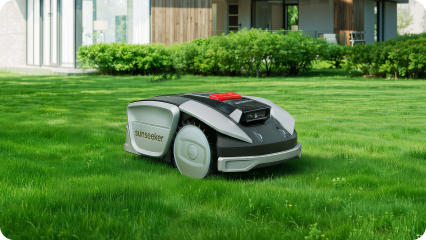
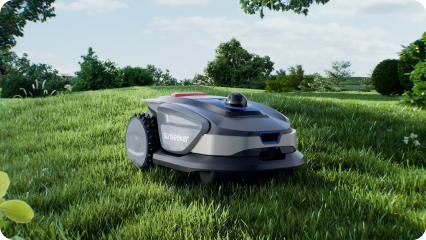
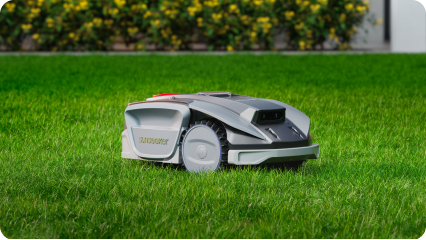
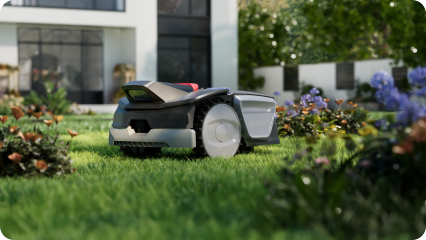
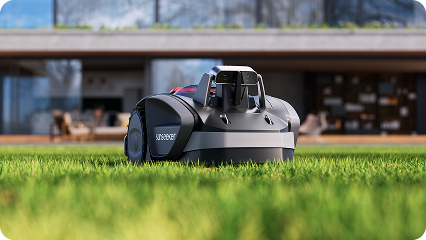
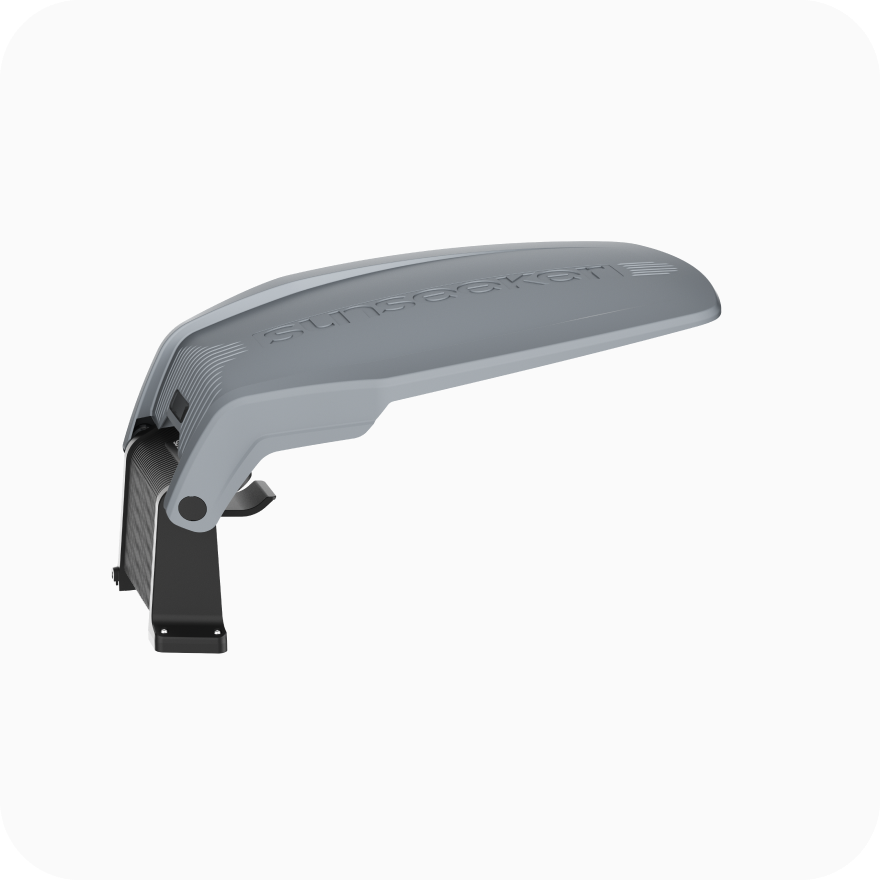
The Sunseeker S4, for example, is a rear-wheel-drive robot lawn mower rated for slopes up to 42% (22°). Its rear wheels provide traction, while direction and route changes are handled by the mower’s autonomous navigation system rather than a rear-wheel-steering mechanism.
A zero-turn mower usually changes direction by varying the speed and direction of the left and right drive wheels. One side can slow while the other moves faster, allowing a pivot that can approach a zero-radius turn. That is different from physically angling rear wheels. Differential steering is highly agile, but abrupt pivots on soft or wet turf can scuff the grass, so smooth control inputs matter.
Four-wheel steering turns both axles in a coordinated pattern, often reducing the turning circle while keeping the machine more closely aligned with its travel path. Articulated steering bends the mower chassis at a central joint. Both can work well around trees and on winding lawns, but the steering feel, maintenance points, and deck path differ from a machine whose rear wheels alone provide steering input.
Rear steering changes more than the turning circle. It also changes where the mower swings, how the tires load the turf, and what the operator sees while trimming close to obstacles.
The main benefit is a tighter path around fixed objects. As the rear wheels angle, the back of the mower moves laterally while the front follows a more direct arc. This can reduce backing around trees, lamp posts, and small landscape islands. Check the manufacturer’s published uncut-circle or turning-radius figure, because two rear-steer mowers can behave very differently. The deck may still leave a strip if it sits well inside the wheel track.
Steering layout does not replace traction. On slopes, tire tread, drive-wheel load, differential behavior, ground moisture, and the mower’s rated slope limit are more important than steering location alone. A rear-steer machine may feel responsive as the rear swings through a turn, so wide, gradual direction changes are preferable on inclines. Avoid sharp downhill turns and never exceed the slope limit in the operator’s manual.
Any mower can mark turf if a tire pivots while carrying high load. Rear wheel steering can reduce the need for stationary pivot turns, but a very sharp steering angle can still scrub the rear tires across soft soil. Slow down before the turn, keep the mower moving, and avoid repeated tight circles in the same spot. Extra care is useful after rain, on newly established grass, and near irrigation areas where soil stays soft.
Reverse motion can feel unfamiliar because the rear of the mower responds quickly to steering input. Small corrections are usually easier to control than large steering movements. Before trimming close to a wall, fence, or parked vehicle, practice in an open area and learn the rear overhang. The useful reference point is not only the deck edge; it is also the path of the rear wheel and body as the machine swings.
Rear wheel steering is most useful when tight maneuvering is a regular part of the mowing job. Curved borders, narrow access points, obstacles, and frequent direction changes are the situations where its extra agility becomes noticeable.
Rear wheel steering can make a ride-on mower easier to place around trees, beds, narrow turns, and other obstacles, but steering geometry is only one part of the decision. Check turning radius, deck position, traction, slope rating, reverse behavior, and service needs together. Obstacle-heavy yards may benefit most, while open lawns place less value on the feature. For routine automated upkeep, Sunseeker’s robot mower range offers another way to manage established grass with mapped navigation and scheduled cutting.
Rear-wheel drive can feel less nimble than front-wheel drive when you need to pivot a walk-behind mower around many obstacles, because lifting the front wheels does not disengage the powered rear wheels. On some ride-on designs, rear drive also adds drivetrain complexity. It should not be confused with rear wheel steering, which describes directional control rather than power delivery.
Four-wheel steering can keep the mower aligned more naturally through a turn and reduce the wide rear swing found on some steering layouts. That can improve control on rolling ground. It does not increase the manufacturer’s slope rating, though. Tire grip, speed, surface moisture, center of gravity, and the mower’s published incline limit still control safe operation.
Match the mower to yard size, obstacles, slopes, storage space, and the amount of trimming you want to do afterward. Rear wheel steering suits obstacle-heavy lawns that need frequent tight turns. Zero-turn models suit large areas with many direction changes, while conventional front-steer tractors are often practical for open lawns, towing tasks, and familiar handling.