

24/08/2026
-
Products
-
V Series
-
-
-
-
Explore
- About Us
- Where to Buy
- Support
Products
V Series
Explore
Four driven wheels help when damp grades, ruts, or sustained slopes keep causing spin—not only on one steep bank. An awd robot mower still needs sensible turning, enough coverage margin, suitable cutting dimensions, and navigation that recovers on uneven ground. Measure the hardest wet route before treating AWD as automatic insurance.
A steep bank is not the only place a mower can lose traction. Damp shade, shallow ruts, soft turf, and tight turns can make a 2WD machine spin even when the average lawn looks easy. An awd robot mower can spread drive force across four wheels, but the yard still has to suit its slope rating, steering behavior, navigation, and cutting system. This guide shows how to judge those factors and when AWD provides a practical advantage rather than an unnecessary specification.
AWD earns its value when loss of traction is a recurring yard condition rather than an occasional exception. Buying decisions should start with how the mower behaves on the property’s hardest repeatable routes.
Slope ratings should be treated as design limits, not a target for routine operation everywhere. A 60% grade is about 31°, while a 42% grade is about 23°. Measure the steepest part of the actual mowing line, not the average yard. Wet grass, loose soil, side slopes, sharp turns, and a drop at the bottom can reduce usable traction even when the percentage is within the nominal limit. Leave margin near ponds, retaining walls, and traffic areas, and follow the product safety guidance for boundary placement around hazards.
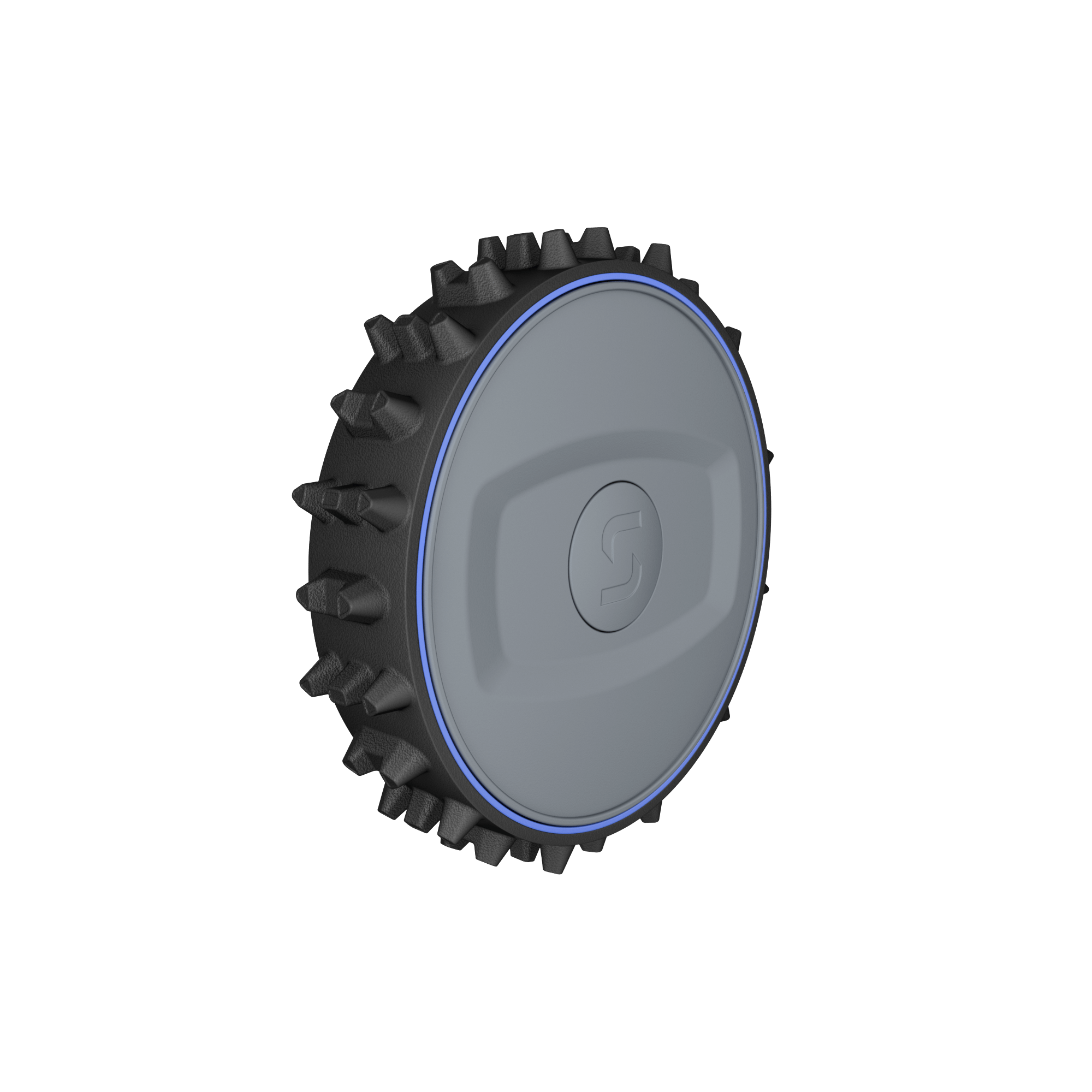
AWD helps because more driven wheels can share tractive force when one wheel loses grip. It is most useful on rolling ground, ruts, damp turf, and transitions where a 2WD mower might spin or stall. Tire tread, weight distribution, suspension, wheelbase, and control software still matter. A mower that can climb a steep straight slope may behave differently when turning across it. Inspect the yard for exposed roots, holes, and soft edges; repairing severe ground defects protects the turf and often improves reliability more than relying on drive power alone.
Coverage should be based on the sum of all mowable areas, not the property lot size. Subtract buildings, beds, ponds, patios, and non-grass surfaces, then add a margin for seasonal growth and inefficient routing. A mower rated close to the exact calculated area may spend more time charging during fast spring growth. For example, if three lawn zones total about 3,238 m², selecting a system comfortably above 3,238 m² provides more schedule flexibility than treating the rating as a daily guarantee. Terrain, grass density, cutting height, and travel between zones all affect real cycle time.
Cutting-height range should match the grass type and the way the lawn is used. A wider adjustment range gives room to keep turf longer during heat or shade and gradually lower it when growth is strong. Avoid removing more than roughly one-third of the leaf blade in a single cut; if grass is overgrown, reach the target height over several sessions. App-controlled height is convenient, while manual adjustment is acceptable when the yard does not need frequent changes. Check the mower’s actual range against the height you normally maintain rather than choosing on range alone.
Wider cutting systems cover more grass per pass, but width should be judged together with maneuverability. A broad deck can reduce the number of lanes on an open lawn, while a narrower mower may move more easily through tight gates, tree clusters, or narrow side yards. In multi-zone properties, use the narrowest required corridor as a constraint before chasing maximum width. Cutting width also interacts with path planning: systematic parallel lanes can make efficient use of a modest deck, whereas random travel can give away some of the theoretical capacity.
A robot mower repeatedly turns at row ends, around obstacles, and when entering new zones. On soft or wet grass, aggressive pivot turns can scuff the surface even if the mower has excellent climbing traction. Look for controlled steering, smooth speed changes, and route planning that avoids unnecessary rotation in one spot. AWD should be paired with software that manages wheel speed during turns. If a problem area stays damp after rain, adjust the schedule so mowing resumes after the surface firms up rather than expecting the drivetrain to solve a soil-condition problem.
Once you know the yard’s slope, size, and layout, focus on the features that affect everyday mowing performance. For an AWD model, traction is important, but it should be considered together with navigation accuracy, cutting range, zone management, and how well the mower handles uneven or soft ground.
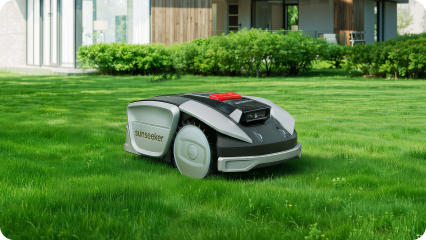
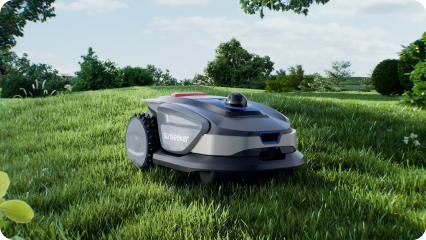
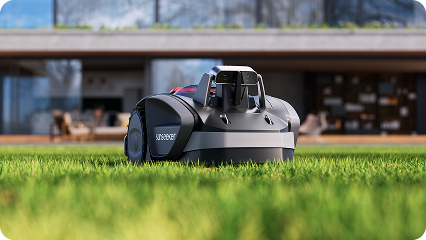
The Sunseeker S5 is designed for lawns where slopes and changing terrain are part of the regular mowing route. It combines RTK and VSLAM navigation with all-wheel drive, helping it maintain stable movement and follow planned routes across more demanding areas. It supports lawns up to 1,600 m² and can handle slopes of up to 60% or 30°.
AWD becomes valuable when traction problems repeat across normal mowing routes rather than appearing only in an isolated patch. The yard itself should show whether the extra driven wheels are useful.
AWD is worth the extra complexity when traction is a recurring limitation rather than an occasional edge case. If the yard contains sustained slopes above roughly 20-25%, damp shaded grades, uneven transitions, or areas where a 2WD mower repeatedly spins during turns, driving all four wheels can improve progress and reduce recoveries. On a flat, firm lawn with broad passages, AWD may provide little practical benefit. Measure the steepest sections and observe the ground after rain. If the difficult terrain appears on every mowing route, AWD is a functional requirement; if it appears only in one repairable rut, improving the ground may be the simpler solution.
To compare drive systems and yard capacities, browse Sunseeker’s robot lawn mower range using the same slope and terrain measurements.
AWD is useful when slopes, damp grades, ruts, and uneven transitions create repeated traction problems during normal mowing. The decision should still account for turning behavior, ground condition, navigation, cutting range, and enough coverage margin for the whole property. Measuring the steepest working routes after rain gives a better picture than relying on the average slope. Sunseeker’s AWD mower options combine traction with mapping and planned navigation so demanding terrain can be managed as one coordinated mowing workflow.
AWD means all-wheel drive: drive torque is available at all four wheels instead of only one axle. On a robot mower, that can improve traction on slopes, uneven ground, and damp transitions. Tire design, suspension, weight distribution, and software control still determine how gently and reliably the mower moves on turf.
AWD adds driven components, so there are more wheel and drivetrain parts to keep clean and inspect. Routine mower care is still straightforward: remove grass buildup, check blades and wheels, keep sensors clean, and follow the maintenance schedule. Avoid pressure or chemicals that the manual does not allow, and inspect after muddy operation.
A lithium mower battery commonly lasts several years, but there is no single fixed lifespan. Charge cycles, storage temperature, depth of discharge, heat, winter storage, and how many hours the mower works each week all affect aging. A practical expectation is roughly 3-5 years before noticeable capacity loss in normal residential use, with wide variation.