Think a robot mower has to be expensive to perform well? The newest budget models challenge that assumption, offering smart mapping, quiet cutting, and fully automated care without the high price tag. Here’s what happens when innovation gets budget-friendly.

The core promise of any robot mower is simplicity and reclaimed time. Models in the budget segment, typically priced between €800 and €1,500, fulfill this promise for owners of small-sized lawns. While they may not have all the bells and whistles of their premium counterparts, their focus is squarely on delivering reliable, consistent cutting and fundamental automation.
Gone are the days when "budget" meant basic. Today's affordable units are equipped with a surprising level of sophistication.
Most are fully autonomous, capable of managing their own charging cycles and pausing operations during rain if equipped with a rain sensor. The majority now feature companion smartphone applications, allowing for remote control, schedule customization, and cutting height adjustments.
They are designed to navigate gentle to moderate slopes and handle lawns with straightforward layouts effectively and quietly. The key for the consumer is understanding the smart compromises—prioritizing day-to-day reliability and ease of use over advanced features that may not be necessary for their specific property.
When evaluating budget robot mowers, it's crucial to focus on the features that impact performance and durability directly.
Efficient Navigation: Most budget robot mowers still use perimeter wires but now feature smarter navigation. Advanced sensors detect obstacles, while systematic pathfinding ensures complete coverage. Some newer models even offer vision-based, wire-free setups for easier installation.
Smart Control & App Integration: App connectivity is now standard in this category, serving as a smart remote for scheduling, height adjustment, and status monitoring. An intuitive interface makes setup simple and daily oversight effortless.
Quiet, Eco-Friendly Operation: As fully electric devices, robot mowers are inherently quieter and more environmentally friendly than traditional gas mowers. Their noise levels are low enough to allow for early morning or evening mowing without disturbing neighbors. They are also highly energy-efficient, consuming minimal electricity per charging cycle.
Essential Safety: Safety remains essential, even for budget models. Standard features include automatic blade stop when lifted and collision sensors for gentle obstacle avoidance, ensuring safe operation around children and pets.
To provide a clear comparison, the following table summarizes key specifications for three representative models in the budget class. This illustrates the range of capabilities available.
|
Key Indicators |
Eufy E15 |
Navimow i105 |
Sunseeker V3 |
|
Price |
€1,499 |
€999 |
€1,099 |
|
Recommended Lawn Size |
0.2 acre (800m²) |
0.125 acre (500m²) |
0.15 acre (600m²) |
|
Max Slope Capability |
40% (18°) |
30% (17°) |
42% (22°) |
|
Navigation System |
Pure Vision FSD Technology |
EFLS 2.0 (AI-enhanced RTK) |
Vision AI |
|
Setup Method |
Wireless setup |
Wireless setup |
Wireless setup |
|
Cutting Width |
8.0 in |
7.1 in |
7.1 in |
|
Cutting Height Range |
1.0–3.0 in |
2–3.6 in |
1.6–3.2 in |
|
Noise Level |
56 dB(A) |
58 dB(A) |
55 dB(A) |
|
Waterproof Rating |
IPX6 |
IP66 |
IPX5 |
|
Charging Time / Runtime |
90–110 min / 90–110 min |
90 min / 60 min |
90 min / 60 min |
(Data sourced from publicly available websites as of 04/12/2025 and provided for reference only)
The market for budget robot mowers is highly competitive, with each model offering a distinct blend of strengths.
Eufy E15 leads with its vision-based navigation that requires no boundary wires, offering maximum installation convenience. With the quietoperation (56 dB) and strong IPX6 waterproofing, it suits smaller lawns where user-friendly operation and discreet performance are valued.
Navimow i105 stands as the most budget-conscious choice at € Its AI-enhanced RTK navigation provides reliable positioning for basic lawn care needs, though it's best matched with smaller (500m²), relatively flat properties due to its more limited slope capability and runtime.
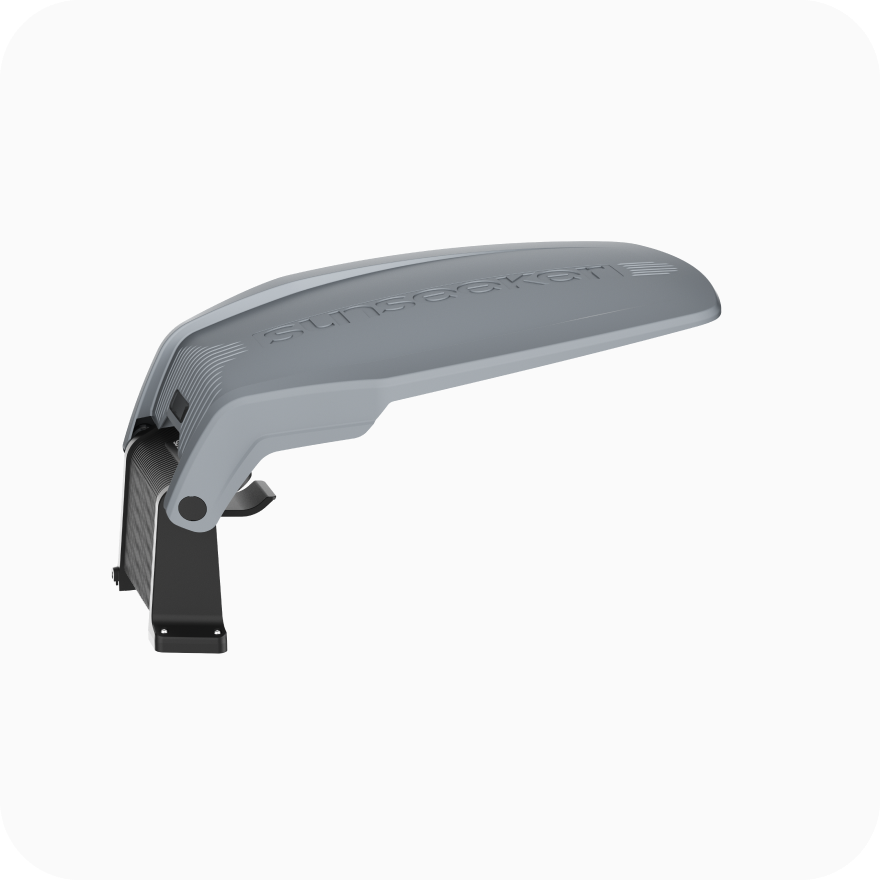
Sunseeker V3 delivers outstanding value at its €1,099 price point, featuring class-leading slope handling (42% / 22°) that outperforms both competitors. With solid cutting width and better coverage than Navimow, it's the optimal choice for challenging terrain where budget and performance must balance.

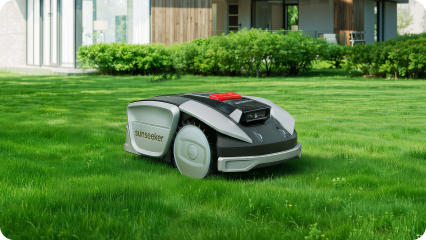
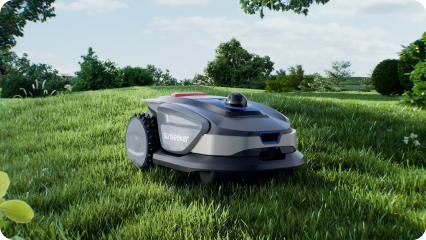
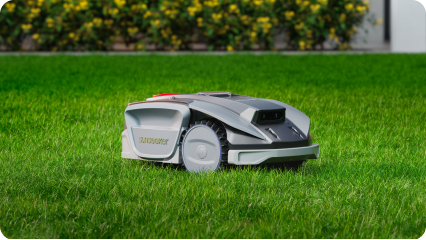
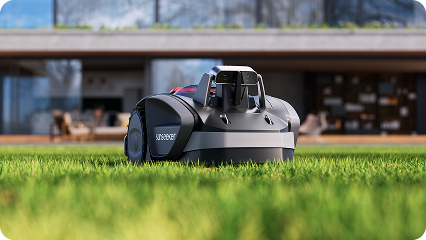
Sunseeker V3 robot mower with Vision AI dual-eye system
Now, after seeing what these budget-friendly models can do, you might be asking yourself: 'What do I actually get by spending a bit more?' It's a fair question, and the answers might surprise you.
These machines are engineered for efficiency and value on properties typically up to 800m². They excel at core automation—scheduled mowing, basic obstacle avoidance, and systematic coverage. They are the ideal solution for homeowners seeking a consistent, well-kept lawn with minimal effort.
The limitations usually involve a slower mowing pace on larger areas, less sophisticated navigation for highly complex layouts with multiple isolated zones, and a narrower cutting deck.
Premium models are built for scale and intelligence. Designed for lawns up to 1500 m² or more, they feature more powerful motors, wider cutting decks, and advanced navigation systems that create optimized mowing routes for maximum efficiency.
They are generally faster, quieter, and more adept at handling steep slopes and intricate garden landscapes. Their companion apps offer deeper customization, detailed lawn analytics, and more robust connectivity. The premium experience is one of total automation; the mower intelligently adapts to almost any condition without requiring owner intervention.
To ensure your budget robot mower performs at its best for years to come, a little strategic care goes a long way.
Before the first mow, walk your lawn and remove large sticks, toys, and other debris. Fill in small holes and depressions, and trim any overgrown edges. A clear and relatively even terrain allows the mower to navigate more efficiently and reduces the risk of blade damage or wheel slippage.
Robot mowers work best with a "little and often" approach. Programming the mower to run three to four times a week results in a healthier lawn, as tiny grass clippings decompose quickly and act as natural fertilizer. This method also places less strain on the mower's battery and motor compared to tackling long grass infrequently.
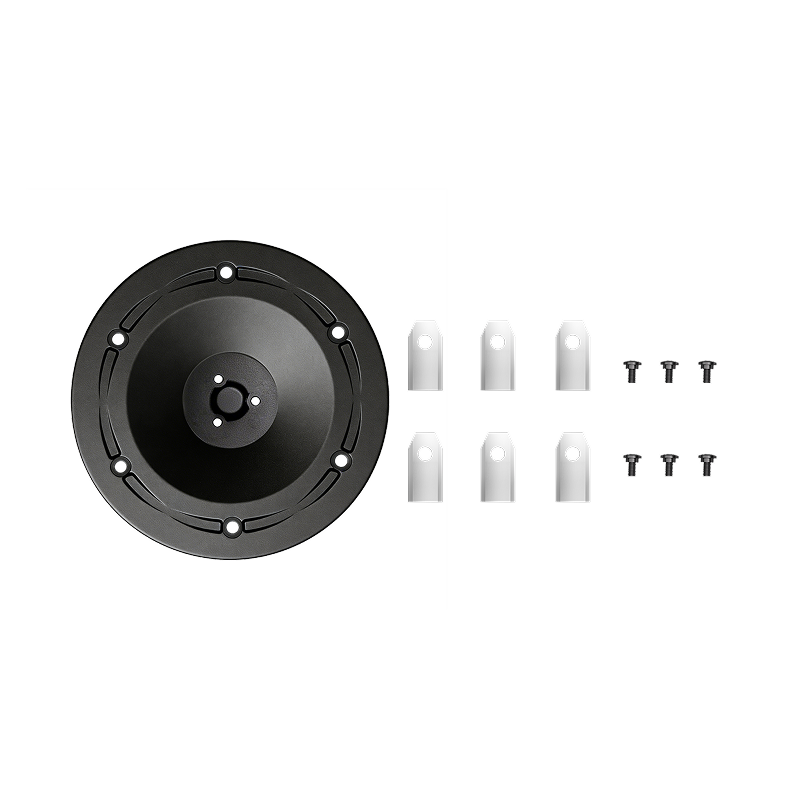
The cutting blades are consumable items. A sharp blade makes a clean cut, which promotes healthy grass growth. A dull blade tears the grass, leaving it susceptible to disease and resulting in a brownish, ragged appearance. Inspect the blades monthly and replace them as needed, typically once or twice per mowing season.
Install the charging base on a flat, stable surface in a shaded location. Ensure the area around the base is clear to facilitate easy docking. For models that rely on wireless signals for navigation, a location with good reception is crucial.
Don't just use the app for starting and stopping. Explore features like creating exclusion zones (if supported), adjusting schedules based on weather or grass growth season, and reviewing mowing history. Fully utilizing the software enhances both the convenience and effectiveness of your automated system.
The search for a truly smart yet affordable robotic mower gets a lot easier once cost-effectiveness meets real intelligence. Today’s newer budget-friendly models bring features that used to be “premium only”, like smarter navigation, quieter cutting, solid rain sensors, and full app control, all within a surprisingly accessible €800–€1,500 range. You end up with a dependable, low-maintenance system that keeps your lawn looking sharp on autopilot, giving you more time back every week.
Instead of just staying on top of your lawn, take control of it. Models like the Sunseeker V3 show how intelligent, budget-conscious automation can elevate your outdoor routine with almost zero effort.
Charging frequency depends on battery capacity and lawn size. Most budget-friendly models run for 1–2 hours per charge. Larger lawns may require multiple cycles, while advanced models can return to their docking station automatically and resume mowing after charging, minimizing manual intervention.
Modern robot mowers are easier than ever to install. Wireless mapping and app-guided setup replace the old boundary wire systems. For example, the Sunseeker V3 can map and start mowing in just minutes, with virtual boundaries adjustable directly from the app.
Generally speaking, most robot mowers are designed for regular maintenance rather than initial heavy-duty clearing of very tall or overgrown grass. If your lawn has been neglected for a while and the grass is very high, you’ll likely need to use a push or ride-on mower first to bring the height down to a manageable level. After that, a robot mower can take over and keep things neatly trimmed with far less effort on your part.